Superfund Research Program
The NIEHS Superfund Research Program (SRP) is a network of university research centers that are designed to seek solutions to the complex health and environmental issues associated with the nation's hazardous waste sites. The research conducted by the SRP is a coordinated effort with the United States Environmental Protection Agency (US EPA), which is the federal entity charged with cleaning up the worst hazardous waste sites in the United States. Funding is received through an Interagency Agreement with the US Environmental Protection Agency using Superfund Trust monies.
Who funds it
Funded by the National Institute of Environmental Health Sciences (NIEHS), part of the National Institutes of Health (NIH).
How long
Established by the Superfund Amendments and Reauthorization Act of 1986 — nearly 40 years of interdisciplinary research.
Its purpose
Reduce the health and environmental risks of hazardous substances at Superfund sites — connecting science with the communities most affected.
The SRP funds a national network of multi-project research centers at universities across the country. Each brings together biomedical and environmental scientists, engineers, trainees, and community engagement teams — tackling how toxicants move through ecosystems and bodies, developing new remediation technologies, and ensuring science reaches the people who need it.
Centers are organized around Multidisciplinary Research Projects supported by Research Support Cores, an Administrative Core, a Community Engagement Core, a Research Translation Core, and a Training Core preparing the next generation of environmental health scientists.
Beyond the centers, SRP funds Individual Research (R01) projects, Small Business Innovation Research (SBIR/STTR) awards, and K99/R00 career development awards. SRP-funded science has shaped EPA cleanup standards, informed fish consumption advisories, advanced PFAS and arsenic research, and produced field-deployable sensors and bioremediation tools used at Superfund sites nationwide.
The SRP Annual Meeting brings the entire network together each fall — center directors, project leaders, trainees, community partners, and federal staff from NIEHS, EPA, ATSDR, and other agencies — to share results, build collaborations, and chart the program's next chapter.
Bridging discovery and impact
Established in 2009 and directed by Dr. Robyn Tanguay, the OSU Superfund Research Center identifies polycyclic aromatic hydrocarbons (PAHs) in the environment, characterizes their toxicity, and determines what levels are safe for human health.
The Center brings together a multidisciplinary team across four Research Projects — spanning PAH fate and exposure, health outcomes, mixture toxicity, and remediation — working with Support Cores at OSU and the Pacific Northwest National Laboratory. Since the Gulf of Mexico oil spill, the Center has an added focus on petrogenic PAHs found in crude oil.
The 2026 Annual Meeting theme — Bridging Science, Communities, and Translating Research to Practical Solutions — reflects the Center's core conviction: that the most meaningful science is shaped by, and returned to, the communities it serves.
Visit the OSU SRP Center website →Discovery
Investigating polycyclic aromatic hydrocarbons (PAHs) and their emerging health risks.
Community
Partnering with communities most affected by environmental contamination.
Translation
Turning research into actionable strategies for safer environments.
Training
Preparing the next generation of environmental health scientists.
Preparing the next generation
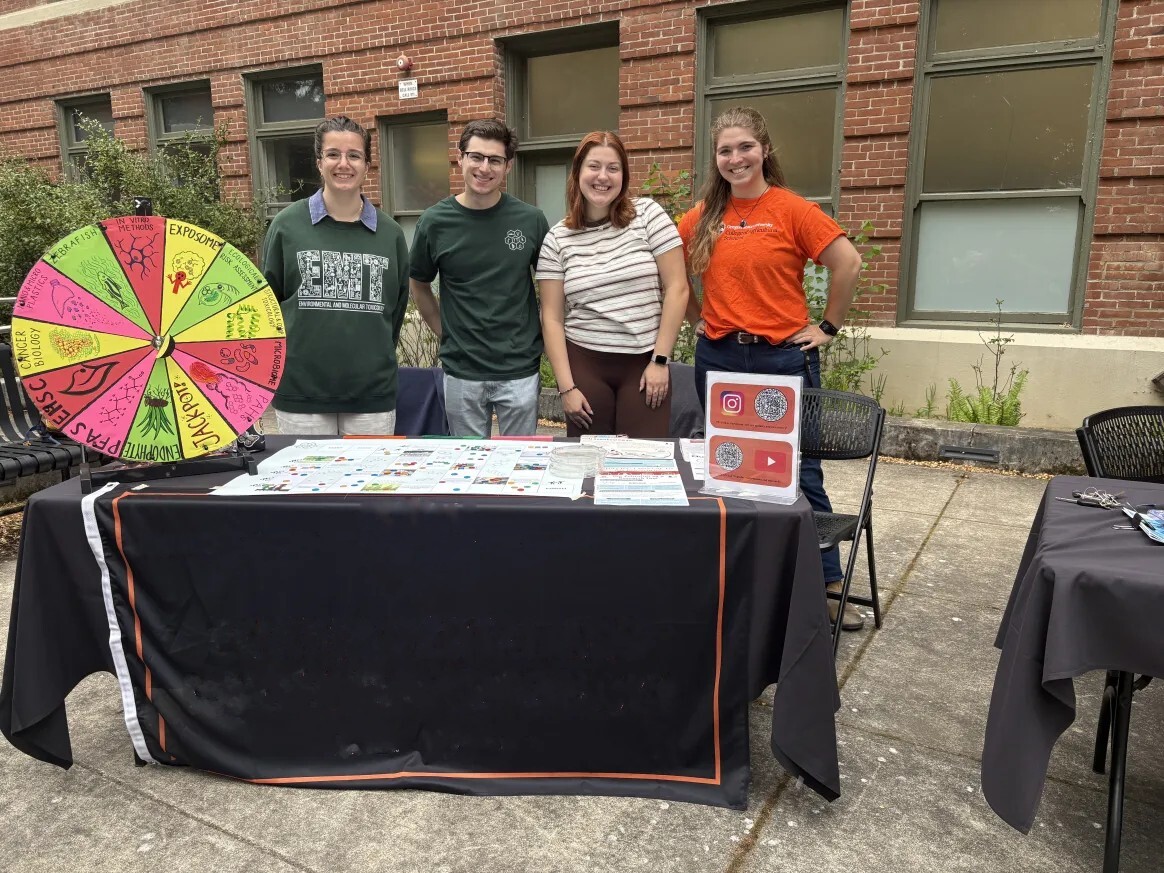
OSU SRP trainees move fluently between the lab bench and the community — designing studies, communicating risk, and building tools like the interactive research wheel pictured here to make environmental health science accessible to the public.
The Center's Training Core supports graduate students and postdocs across all four research projects, with mentorship in interdisciplinary science, community engagement, and translational research.
With thanks to our supporters
Sponsor announcements coming soon. Interested in supporting the 2026 meeting? Get in touch.